Chapter 39: The proud rose flattering with the wind
---John McGahern
Charles awoke early in the morning, still weary from the day before. He sighed heavily as he stretched his sore muscles. He took a mont to collect his thoughts, his mind still full of the preparation made the previous day. As he rose, Charles could hear the sounds of camp life beginning all around him. He knew he needed to get up and start his day, but his body still craved rest. He knew he had to move on, though, and with a deep breath, he stepped out of his tent into the morning sunlight, ready to face the day.
Charles was currently looking forward to receiving a letter from the pope absolving him of the offense against the monastery. Charles needed to receive this ssage urgently because, in order to uphold his authority over the Sicilian Crown, he was inextricably bound to the pope. He was anxiously awaiting the pope's response after asking for pardon for his wrongdoing. The letter would serve as a token of the church's pardon and a guarantee that Charles would not be excommunicated, allowing him to continue his campaign without fear of reprisals.
The coming of an ambassador from Ro was announced by a servant as Charles was just beginning to have breakfast. Charles' heart raced with anticipation as he realized that this was probably the ssenger with the letter he had been waiting for. Charles received the letter from the servant and nervously opened it.
*To the Lord's faithful servant
I hope that God blesses you and your family.
I shall be honest with you, my child, for deep sorrow took hold of when I read your letter.
I called you from France to safeguard the church, not to exploit it. I want you to be aware that what you did would be sufficient to cause the church to excommunicate you, and you would suffer the sa fate as the opponent you just overca.
But God's word advises us to seek forgiveness and repentance. Given that you expressed regret for your actions, I assu you have made ands and deserve our forgiveness. However, you must defend the church from impending destruction that will befall God's house in order to demonstrate your repentance. You have my permission to travel to Ro to assu your responsibilities and make ands for your wrongdoing with good deeds.
I have to inform you that many of the communes are divided between serving Conradin or the church. May God have rcy on them.
It does not help the fact that you have remained mostly passive since you took hold of the throne, and many people have interpreted this lack of action as a sign of weakness. Many ghibellins in Florence are becoming restless, and the Guelph regimè may soon be turned into a ghibellin one. As such, I urge you to go to Florence with an army and show that you are more than present in the current Italian struggle. Your army will reinforce the position of the Guelph and weaken that of the Ghibellin. Ti is short, Charles; act fast for all of our sakes.
Your holy father, Clent IV*
As he read the contents of the letter, Charles' face lit up in relief and joy as he realized that the pope had granted him absolution. He imdiately gave orders for his army to prepare to move out.
If that was not all, the Pope even managed to make it look legitimate to take control of the republic of Florence, as he was nad by his Holiness Vicar of Florence. Undoubtedly awakening Charles' inner greed, apparently the Pope knew how to convince Charles to do his bidding.
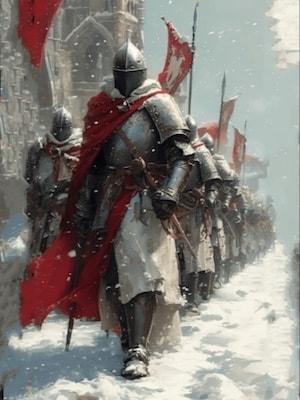
After breakfast, the king climbed aboard his horse and gave the order for his soldiers to follow him. His army consisted of 6,000 soldiers, all ready to carry out the king's orders. With his letter from the pope safely in the pocket of his cloak, Charles turned his horse and led the way, marching his army through the landscape, ready to set off on the final campaign to bring the throne under his thumb. The n followed behind their leader, their loyalty and belief as strong as ever. It seed that their king would lead them to a new campaign and feats of valor, which filled them with pride and purpose; after all, just six months before then, he was just a count, and now he was the monarch of a rich kingdom. They could explain such a rise as a gift of God, and as such, they made themselves out to be God's own soldiers, and as God's soldiers, they expected to be filled with riches by his executioner on hearth.
The march to Florence was estimated to take 20–25 days, depending on the exact route that Charles chose to take. Along the way, it was imperative that the army make a stop at Ro in order to et with the pope and discuss asures against Conradin's arrival. This would be an important diplomatic move, as it could potentially lead to greater support from the pope and other Italian states in the quest to stop Conradin's campaign in Italy. In this way, Charles arrival would not be seen as an attempt to control northern Italy but to protect it from the last Hohenstaufen. Without the use of one's cleverness, a victory is frequently of limited worth; after all, it would be pointless to succeed while being considered an enemy by the rest of Italy, while it would be equally pointless to be seen as a protector by them while instead failing. Charles ordered the troops to march throughout most of the day, stopping only when dusk set, so of the day, stopping only when dusk set, so that they might get there as soon as possible. After all, he was in allied territory, far from any enemy armies, so he wasn't too concerned about not being properly prepared for an enemy attack during the march.
The monarch ended up having to listen to his n discussing nurous rumors and gossip as they marched, but he was too far away to fully understand what they were saying. Charles made an effort to quell his curiosity by imagining that the army rumors might have varied from speculative debates about the present campaign to intimate chats about family and relationships. They may have discussed anything, including the weather, the most recent front-line news, or even potential future military plans. The monarch was sowhat upset by his soldier talking, but he knew that it was the only way his man could pass the tedious ti spent marching, so he refrained from stopping it.
He understood the value of keeping the army well-fed and well-supplied during these tis, but he also understood the value of allowing his soldiers to unwind and partake in so light banter and humor, particularly during arduous marches or protracted waits in camp. As a result, he chose to engage in brief conversations with his vassals rather than disrupting his warriors while they engaged in idle chatter.
He also respected the fact that Jean was honest and forthright, even when the truth wasn't necessarily what the king wanted to hear. Charles was a capable commander who valued honest advice and was willing to listen to different perspectives, and he was always open to hearing suggestions from his trusted vassals.
Charles turned to his obedient subordinate, Jean, to avoid boredom, and began chit-chatting. Charles frequently sought the counsel of his vassal since he was aware of his intelligence and reliability.
''Tell , Jean, what do you think about our current situation?'' Charles asked with much expectation to hear another's opinion.
''Well, your highness, I think that our situation is very good. We managed to consolidate our position in the kingdom, and ahead of us, we have the opportunity to ensure that after Conrad III, no other person will be able to claim your kingdom." Jean said, trying to cheer up his liege, who had been on the edge, knowing that there was still an obstacle ahead.
''Tell , do you have any suggestions to make for when we will arrive in northern Italy?" Charles continued to inquire to Jean while looking ahead of himself, pondering about things unknown to his vassal, maybe the future or the family that he had left behind.
''Yes, your highness I think that it would be in our best interest to create a defense line near Pisa; after all, Conradin has limited support there, and he will have to be active or else he will lose the already small support he has. As such, I think we should be passive and let him co to us, and prepare according to that.'' Jean suggested after a few seconds of silence , it was likely that Jean in his mind had already devised so plan to suggest to his master during the campaign.
As their conversation continued for the rest of the day, both Count Jean and King Charles likely felt relieved to have soone to talk to and share their worries with. Charles likely felt better after hearing Jean's optimism and confidence in their chances of success, and Jean in the sa way likely felt comforted by the king's reassurance and words of encouragent. It was a beneficial mont for both n, allowing them to relax and take so of the stress off their minds after a tense day of marching and making important decisions.







Reviews
All reviews (0)