Over the next few days, Sobek devoted himself to exploring his new hunting area. He quickly concluded that it was a very favorable place, full of prey that was quite easy to catch; nothing too big and armored, but at the sa ti not too small either. A very good place consequently, where he could easily get a lot of new experience points.
After making sure there weren't other predators too big, he started to rampage.
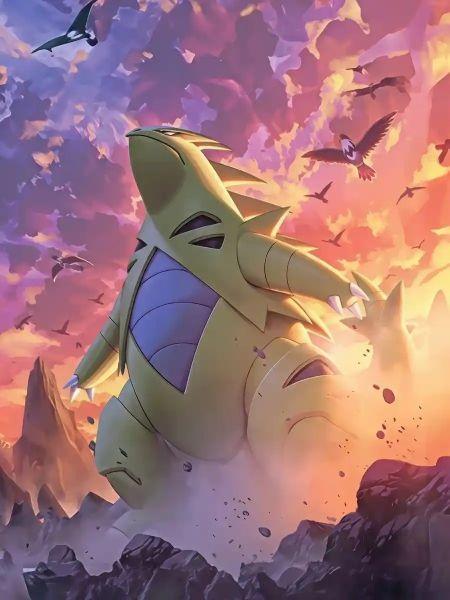
It was now a carnivorous dinosaur 22 ters long and 7.2 ters high, weighing 11 tons, and he could also run up to 23 km/h. He could already almost be considered a mythological monster, a real devastator of lands. There was no way the preys escaped him.
The amount of experience to level up again was 210,000, but in a short ti Sobek had already accumulated over 100,000 points. This is because the preys in that area were particularly slow and easy to catch.
He had found that mostly Permian creatures dominated the area. That was an era when animals were not as gigantic as the dinosaurs would have later beco, even if they could still be considered quite massive. The maximum amount of food he had received so far had been the scutosaurs, but there were also other herbivores he could draw from, although not as large.
One example were the edaphosaurs. These were reptiles with a sail just like him, very similar to ditrodonts and easy to hunt. Because of their posture, as their legs were placed on the sides rather than under the body, they had no hope of escaping from him: they could run fairly quickly, but they soon tired, just like crocodiles or alligators.
They barely provided 5,000 experience points, but Sobek could devour an entire pack on each hunt thanks to their charateristics. Their at was also particularly sweet, making them so of his favorite preys.
By the way, he had also found so ditrodonts. They weren't a challenge to him long ago, so now they didn't represent even the slightest risk. He hadn't even had to try hard to catch them all. He had therefore been able to accumulate many skill points: now he had 6 of them in total.
Of course, not all the animals of that area had a sail on their backs. There were many other creatures more similar to lizards.
One example was the labidosaurus, a representative of a group of primitive reptiles known as captorinids; these animals, endowed with a robust skull and without windows for the insertion of the muscles, were considered among the most primitive of all the reptiles known to the paleontologists of the Earth.
They were the ancestors of all reptiles, dinosaurs, birds and even mammals; it could be said that they were among the progenitors of life completely out of water. In a certain sense, Sobek could have considered them very ancient relatives of him.
Another strange lizard was the varanosaurus. Despite its na it wasn't actually a varan, it was just very similar to it: in reality, it was a mber of the pelicosaurids' group. Its appearance was very reminiscent of a Komodo dragon, except for its smaller head and less graceful gait. With such characteristics, it posed no challenge to Sobek, who devoured it without even bothering to kill it first.
Of course, there were also strange amphibians. One of them was the labirinthodon, a giant amphibian with little legs and a long, strong body similar to a snake's ones, and a head similar to the one of a crocodile. Or the diplocaulus, an amphibian nearly three hundred million years old, with an exceptionally large head relative to its body.
There were also reptiles very close to the amphibians: for example the seymouria, a primitive reptile that like the amphibian still lay eggs in the water.
Sobek had hoped to find other rather large animals as well, such as the tapinocephalus or the estemnosuchus, or even a moschops. He wouldn't have disdained even just a lystrosaurus or a titanosuchus. Unfortunately, although he explored the area for a fair amount of ti, he wasn't particularly lucky. Most of the animals he found were quite small.
Milleretta, askeptosaurus, paradapedon, procynosuchus, robertia, cistecephalus, lycaenops, thrinaxodon, lagosuchus, and many others: they were all too tiny to give him a decent amount of experience or skill points. They weren't even suitable for the role of snacks. For a 22-ter predatory dinosaur, an animal just a few tens of centiters long or more generally less long than a ter was of no use.
However, Sobek's main focus was another. He could still ignore that he didn't find many large herbivores, but he couldn't leave that area without a good trophy, and he knew exactly what was that trophy. He wanted to find the Permian apex predator: a gorgonopsid!
Gorgonopsids was a group of animals that many Earth's paleontologists considered the deadliest carnivores ever to appear on Earth before the dinosaurs. Many species were almost two and a half ters long and equipped with knife-sharp teeth; they were literally a saber-toothed tiger of ancient tis, but even bigger.
Monsters that would have hunt the dreams of the children if they were actually real on the Earth of the twenty-first century... but in that ssy world, they were!
So gorgonopsids were relatively small, like the lycaenops, the leontocephalus or the arctognathus; they were no more longer than one ter and half. However, many species were far bigger: the dinogorgon and sauroctonus could surpass the two ters. But Sobek was aiming for the biggest prize: the largest family representative, the inostrancevia!
Inostrancevia was a gorgonopsid that could reach more than 3,5 ters in length. It was more than any modern carnivorous mammal on Earth. The skull alone was up to 60 centiters long. It had canines-like teeth that could asure 15 centiters in length and a bite force that could rip the skin and crush bones.
Sobek was certain that such a predator could give him a very good amount of skill points. Not only that, but devouring it he would have added another apex predator to his trophy room. He had already eaten the andrewsarchus, the largest terrestrial carnivorous mammal that ever existed, establishing his supremacy over the entire Cenozoic era.
With the inostrancevia, the largest terrestrial carnivore that appeared before the dinosaurs, he would also have sanctioned his dominion over all the creatures from the Paleozoic era.
At that point only the sozoic era would have been missed, and he would have obtained it only by killing and devouring the majestic tyrannosaurus rex; but for the mont, he was still too weak for that, so he had to be satisfied with the other two geological eras.
Unfortunately, however, he hadn't had great luck so far.
Gorgonopsids were loners and they had an exceptional nose, so they would certainly have remained out of his way. Unlike carnivores like torvosaurs, they didn't have the slightest hope against him, and they knew it well. Sobek could have killed them with just a kick.
Sobek had no choice except to continue to move and hoped to find almost one of this ancient predators. He didn't disagree this however: he had the chance to observe the Permian ecosystem more.
He really like it because it was so primitive. After all, the Permian period was the first period when animals really completly abandon the water. Even if there were already reptiles during the Carboniferous period, like the little hylonomus or the tiny petrolacosaurus, the majority of them weren't bigger than a small lizard.
It was only in the Permian period that reptiles started to grow and colonized the land.
Basically, Sobek was now observing the first full land-based ecosystem of the Earth!
And that wasn't all. Even if they were still reptiles, the Permian creatures were 'mammal-like reptiles'; that ans that so of their descendants on Earth evolved in the mammals. Mammals that next beca tigers, bears, hippos, horses, elephants, apes and, of course, human beings.
So, Sobek was looking one of the most ancient monts in the humans' evolution history. He really liked it in a certain sense. He felt like he was a witness of a page of History. For a mont he pitied the humans of Earth who couldn't watch that spectacle.
Even if the disappearance of those creatures had been a fundantal event that had led to the chain of events that millions of years later had allowed human evolution, it was still a sha that such incredible animals had vanished.
A disappearing species was always a bad event, because it ant depriving the world of so of its beauty. Even if its ecological niche would be occupied by soone else it would never be the sa thing again. And when a species disappeared, there was no way to bring it back.
It vanished forever in the eternal folds of ti, and only its remains would perhaps have miraculously been preserved to co back to light millions of years later; and very often, it didn't even have this luck and it simply beca part of the 'unknown unknown'.
He wasn't surprised that God had decided to create that ssy world to ensure her creatures to continue to exist. Sobek could feel empathy for that woman.
Because she was a woman, right? Sobek still didn't quite understand it. God with her speeches had only confused him.
He dismissed those thoughts. Now he was a dinosaur and he had no ti and no reason to act like a philosopher! His duty was only hunt, hunt, hunt!






Reviews
All reviews (0)